Taiwanese tire giant MAXXIS have become an integral part of the bicycle world. MAXXIS are one of the most widely specced tire brands in the high-end mountain bike sector. Contrary to popular belief, there is actually no technical difference between tires with a white or yellow MAXXIS logo. The former is only available to OEM customers such as bike brands, while the latter is what you can buy yourself from the shops. For years, MAXXIS have consistently been delivering high-performance products, making a name for themselves as the go-to brand for a lot of riders. But the rest of the industry hasn’t been sleeping and MAXXIS face some steep competition.
Here you’ll find everything you need about mtb tires: The Best Mountain Bike Tire – We had them all!
Casing
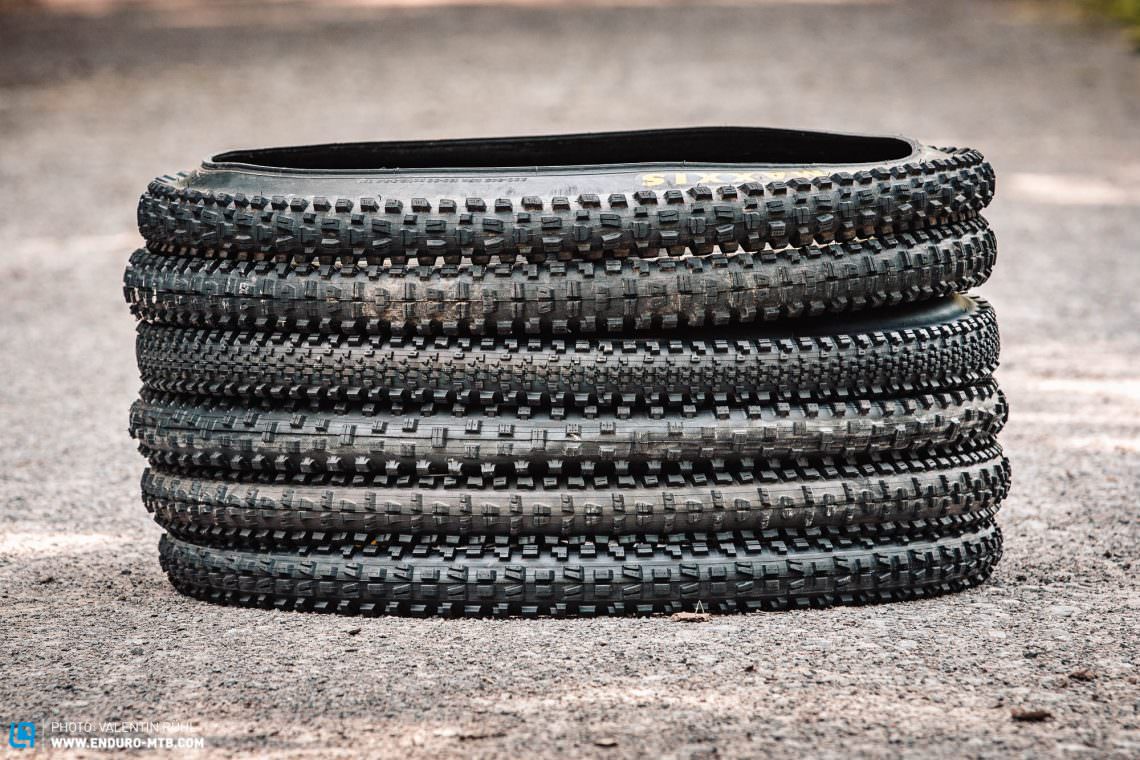
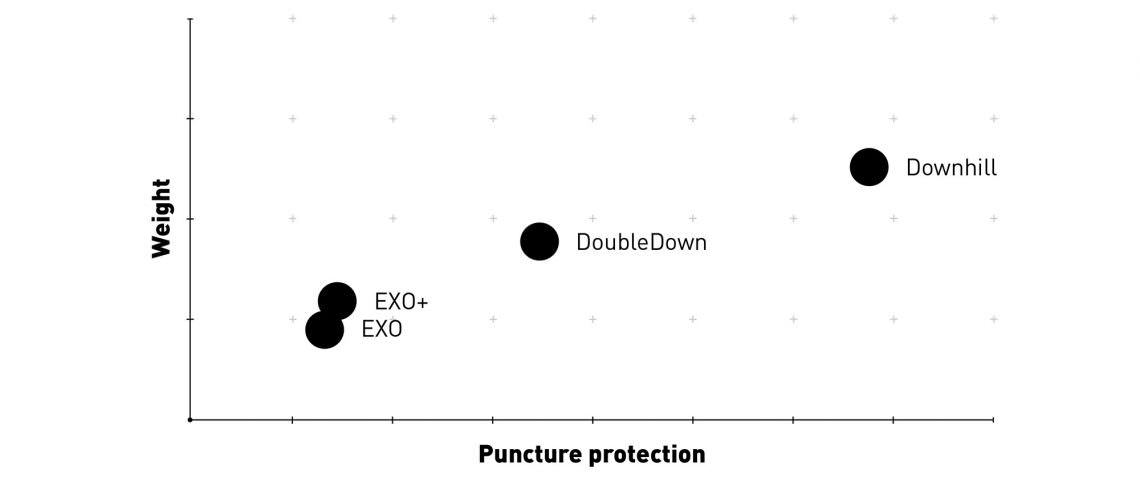
MAXXIS have a lot of different tyre constructions to choose from. The EXO, EXO+ and DoubleDown casings are particularly interesting for Trail and Enduro riders, but even the heavier and more stable downhill carcass may be a viable option for use on the rear wheel. EXO+ is the latest casing in MAXXIS’ portfolio and promises to close the massive gap between the EXO and DoubleDown versions.
EXO
The EXO casing is MAXXIS’ lightest option for Trail and Enduro riders. The fabric of the carcass is reinforced with an additional layer in the sidewall to protect against cuts. The EXO insert extends from the tire bead to the middle of the sidewall. It is less puncture prone than Schwalbe’s Snakeskin carcass though it still folds too easily in corners. As a result, it makes little sense for riders over 90 kg, especially on the rear wheel.
EXO+
EXO+ closes the huge gap between the lightweight EXO and the heavy DoubleDown casings. In terms of weight, the new EXO+ carcass is only slightly heavier than the EXO model. In addition to the EXO insert in the sidewall, MAXXIS use their SilkShield liner which spans bead to bead to cover the entire surface of the tire, offering increased pinch flat protection. In reality, the EXO+ design isn’t quite sturdy enough and heavier, more aggressive riders will still have to run high tire pressures to avoid puncturing the EXO+ carcass. We didn’t notice any major performance leaps compared to EXO with regards to cornering stability and damping behaviour on the trail either. All in all, the performance of the EXO+ is significantly closer to the EXO version than the Doubledown, although that also means it’s quite a lightweight option.
Doubledown
The DoubleDown carcass is every Enduro racer’s preferred option. Pinch flat protection is second only to Schwalbe’s Super Gravity models and the tire damping and the cornering stability are almost at the level of a downhill specific casing. Unfortunately, the weight is up there too. Fitting a DoubleDown tire on the rear is particularly worthwhile for heavier riders, and when combined with an EXO+ front tire your complete setup will still be relatively light. The tubeless DoubleDown carcass seats and inflates easily, and seals relatively well even without tubeless sealant.
Downhill
The Downhill casing has already proven itself thousands of times on the World Cup race circuit. MAXXIS’ heaviest casing delivers excellent damping with the best pinch flat protection in the whole test field. Particularly aggressive riders who ride a lot of fast, rocky trails can get some peace of mind with the downhill casing. For the majority of riders under 100 kg, the downhill casing is completely over-the-top on an Enduro bike. The rolling resistance and weight are just way too high.
Rubber compounds
For their high-end tires, MAXXIS have focussed on triple-compound blends. The 3C MaxxGrip and 3C MaxxTerra compounds are particularly suitable for use on Trail and Enduro bikes. MAXXIS also use a dual compound for some of their rear-specific tires.
DualCompound
MAXXIS’ dual compound is only suitable for the rear tire on both Trail and Enduro bikes. The compound is relatively hard, rolls super fast on any surface and wears quite slowly. These tires are easy on your wallet, especially if you tend to ride on steep and rocky terrain. However, the compound lacks grip for use as a front tire, especially in wet conditions. Here, the DualCompound doesn’t perform well enough either on the centre tread or on the shoulder knobs.
3C MaxxTerra
3C MaxxTerra is MAXXIS’ intermediate triple compound. For Trail riders, it is the go-to option for both the front and rear wheels. The low rolling resistance of the centre knobs is nice to have on the climbs and on moderately inclined flowing trails. The compound of the shoulder knobs on the front tire could be a little softer if you want that extra bit of grip for really hard Enduro use. Nonetheless, the 3C MaxxTerra compound offers the ideal compromise between longevity, grip and cushioning. Most bike brands agree, fitting tires with the 3C MaxxTerra compound on the majority of their builds.
3C MaxxGrip
Grip, grip, and more grip: this aptly describes MAXXIS’ softest triple compound. Actually, it should be called 3G. On the brakes, in corners, in dusty or wet conditions as well as on hard-packed ground, MAXXIS 3C MaxxGrip tires will find something to hold on to. The soft rubber compound offers a ton of cushioning too. The knobs are so soft in warm conditions that small stones stick to them and get flung up against the frame. Of course, that much grip comes at the expense of rolling resistance. If you want to beat your buddies to the top of the mountain, you’ll have no chance with the 3C MaxxGrip compound. Inevitably, MAXXIS’ harder compounds wear much slower than 3C MaxxGrip. Nevertheless, the soft compound lasts long enough for several bike park visits without having to be replaced every two days. Our top choice for the front.
Tread pattern
No other tire brand has as many mountain bike tires on offer as MAXXIS. Besides tires for very specific conditions, they also have a huge range of all-round options to choose from. From fast rolling XC tires to super grippy mud tires, MAXXIS have it all.
HighRoller II
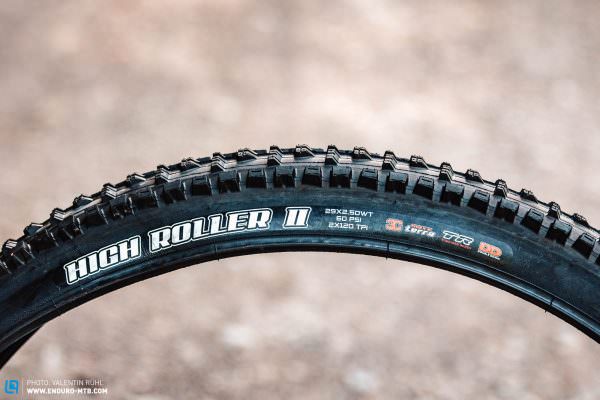
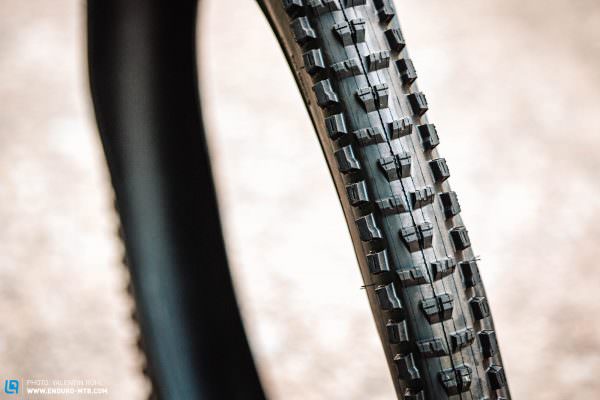
The second generation of the HighRoller has been on the market for several years now. It performs particularly well on loose ground and in wet conditions. The open tread pattern with large gaps between the knobs ensures good self-cleaning properties. The relatively narrow but tall shoulder knobs cut into soft ground on off-camber sections or corners, but they are relatively soft and fold easily in berms or on hard ground. For the centre knobs, MAXXIS have tapered off the leading edge, which is claimed to offer a significant reduction in rolling resistance. Despite their width, the centre knobs don’t deliver the best braking traction due to their low profile height. The lack of transition from the centre to the shoulder knobs means that you’ll have to aggressively lean the bike into corners to maintain grip, which can prove a bit of a challenge for beginners. But master the technique and the HighRoller II is capable of generating an incredible amount of traction in the corners.
Minion DHF
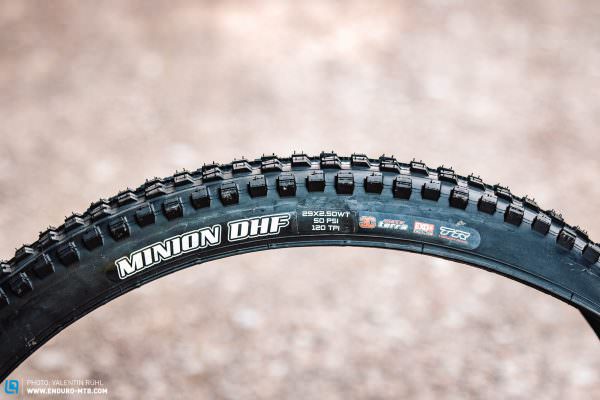
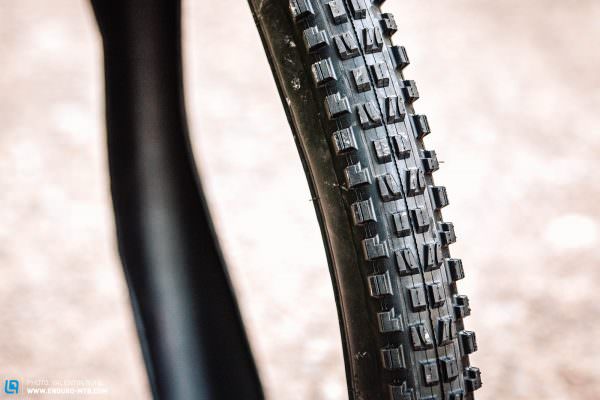
There are two different versions of the MAXXIS Minion. However, the Minion DHF isn’t necessarily only for the front. It also performs very well on the rear wheel of both Trail and Enduro bikes. We find the rounded shape of this large-volume tire easier to lean into the corners than the DHR II. The 2.5″ wide version is our favourite, which is quite a bit bulkier than the 2.4″ Minion DHR II. It also offers a lot of braking traction thanks to its massive centre knobs.
Minion DHR II
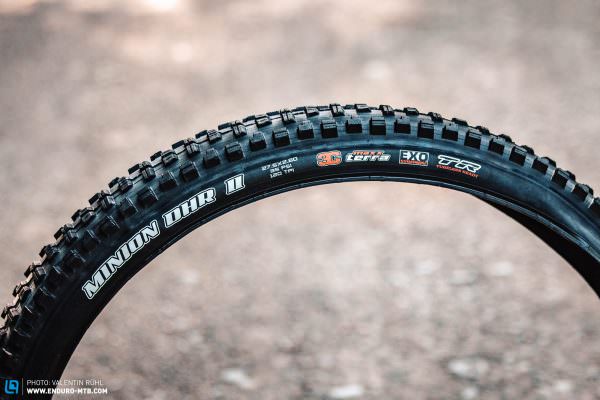
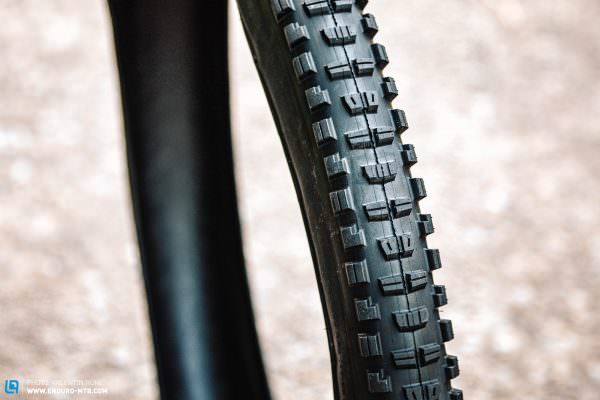
The Minion DHR II was once developed as a rear-specific downhill tire. Since then it’s established itself as an excellent all-round tire and an absolute favourite of our editorial team, whether on the front, rear, or both. No other tire in MAXXIS’ portfolio comes in as many variations. You can choose from almost every imaginable size, casing and rubber compound. It’s got the exact same shoulder knobs as the Minion DHF, which is one of the reasons it’s so popular. They are so wide and well supported that they’re almost impossible to fold, making the handling of the Minion DHR II very direct through berms and on hard ground. It also comes in the WT (Wide Trail) version with a profile that’s been specially optimised for rim widths between 30 and 35 mm. The profile of the WT version is slightly more angular compared to the regular Minion DHF, so its shoulder knobs offer increased traction on loose ground. However, soft forest loam is not the Minion’s forte: it performs best on loose gravel and slippery bike park tracks.
Minion SS
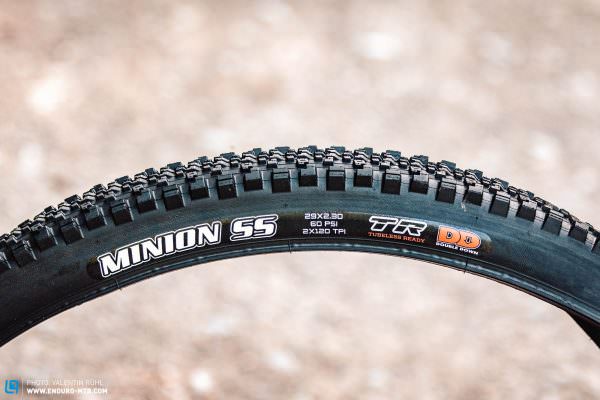
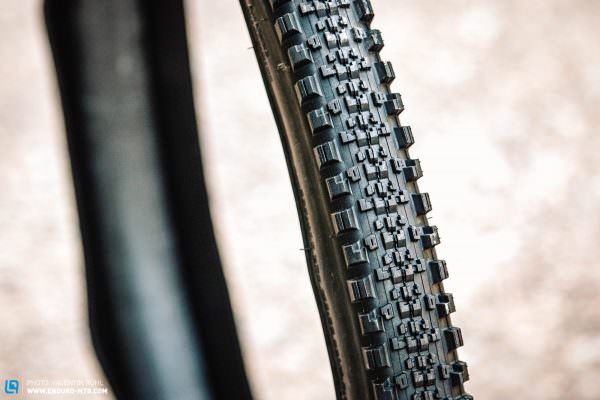
The Minion SS is MAXXIS semi-slick option for the rear wheel. And it really is only for the rear wheel! As long as the trail is dry, the minimal centre tread delivers plenty of braking traction. However, on deep damp soil, this semi-slick tread no longer performs well. This is the trade-off that you’ll have to accept in favour of rolling resistance. The design of the shoulder knobs has been taken from the classic Minion and performs correspondingly well in loose gravel corners as well as berms. Contrary to what its looks might suggest, the transition from the centre to the shoulder knobs is very smooth. We would like to see MAXXIS add a few more variations to this model, especially in the 29″ size.
Dissector
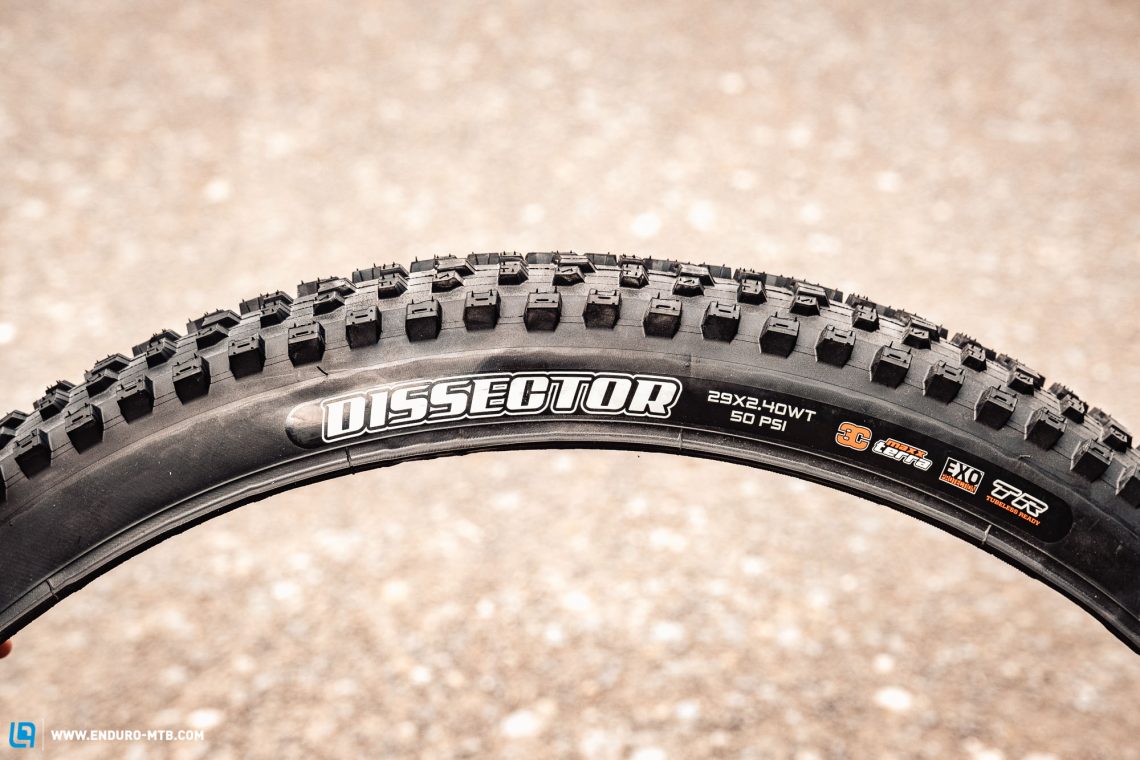
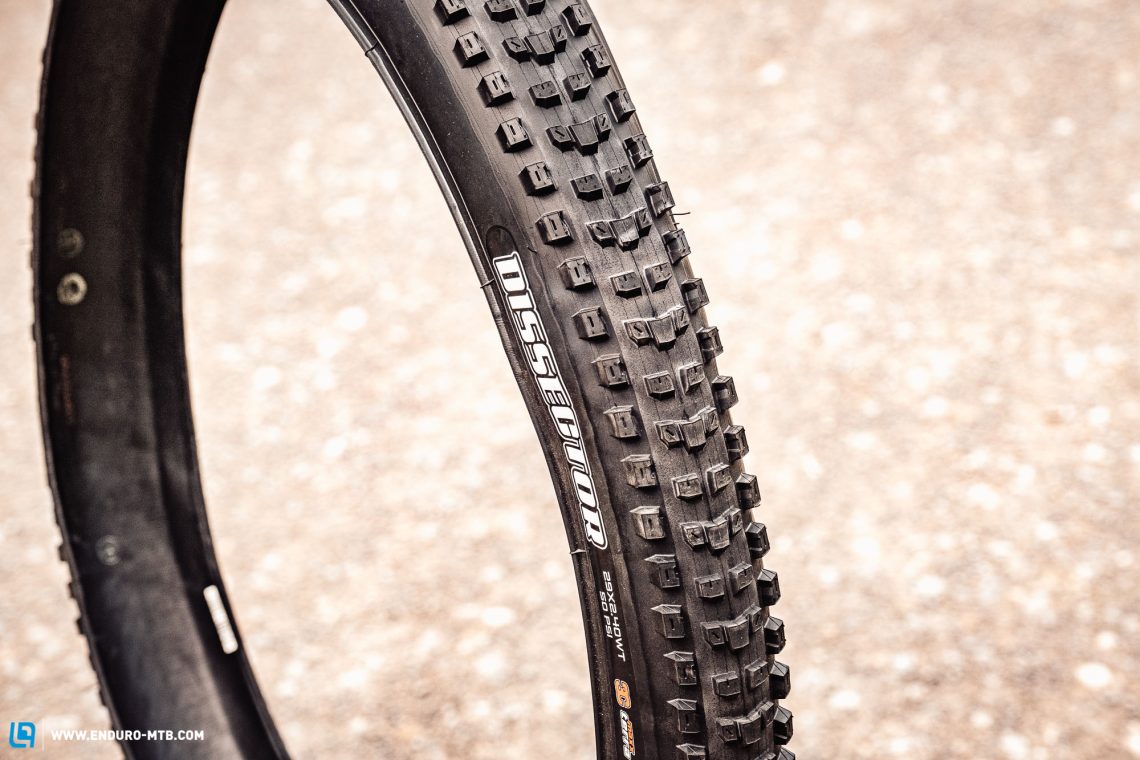
The MAXXIS Dissector was developed in collaboration with Troy Brosnan, who wanted to create an even faster rolling tire for hard packed ground like, for example, bike-park trails. Although the large gaps between the center knobs would suggest otherwise, the short lugs make it an extremely fast-rolling tire. With the well defined transition from middle to shoulder knobs, the Dissector shares similar cornering characteristics with the High Roller II. This also means that you’ll have to actively lean into corners if you want the tire to dig into the trail. In contrast to the Highroller II, the shoulder knobs of the Dissector don’t buckle as easily and make it easier to control the bike in fast berms. The Dissector is a good choice both on natural trails and at the bike-park and in wet conditions it sheds mud better than the Agressor thanks to its widely-spaced knobs and low profile. The lineup is still missing a Doubledown version for tough enduro applications but we’re sure MAXXIS will make up for it and release one soon. On the front wheel, even the 2.6 ”wide version of the Dissector is only recommended for dry, hard-pack bike park trails, simply because it lacks braking traction.
Aggressor
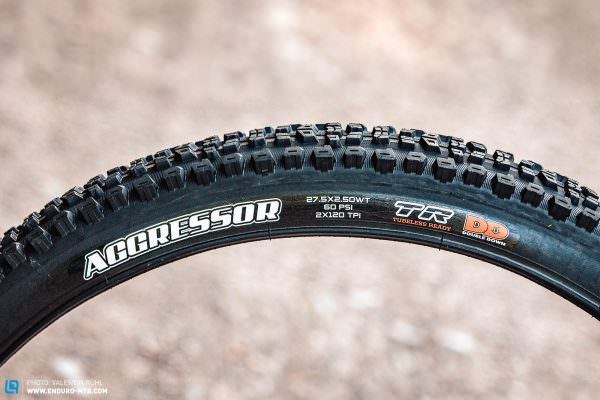
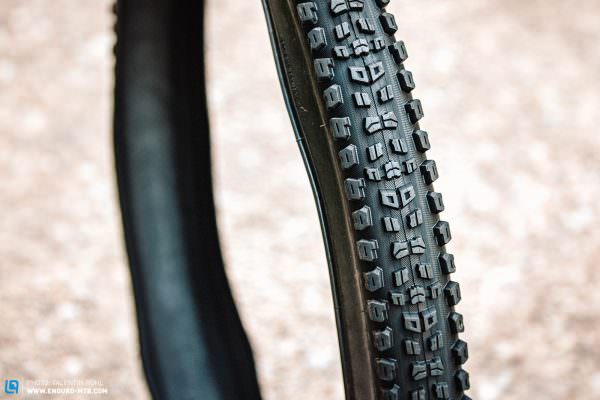
The name says it all. The MAXXIS Aggressor could hardly be more knobbly. Interestingly, it still rolls very well on the climbs, due to the arrangement of the centre knobs that form a tightly spaced tread pattern. As a result, the Aggressor with its grippy shoulder knobs is an ideal choice for a fast rolling rear tire on an Enduro or Trail bike. Paired with a grippy front tire (a Minion, for example) it’ll also make for a good companion on alpine adventures that involve a lot of climbing. It is only available in the harder dual rubber compound, which is absolutely sufficient for the rear in dry conditions. A good choice for budget conscious riders.
Shorty Generation 2
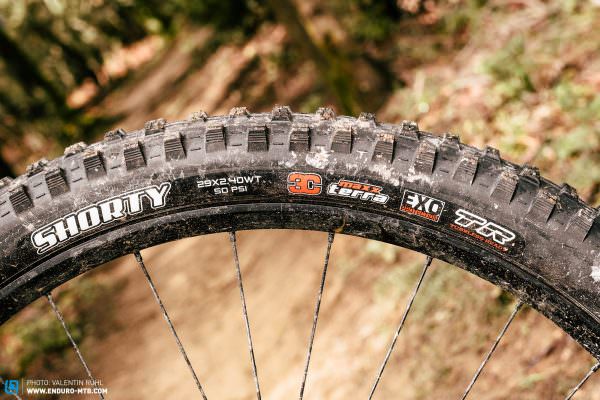
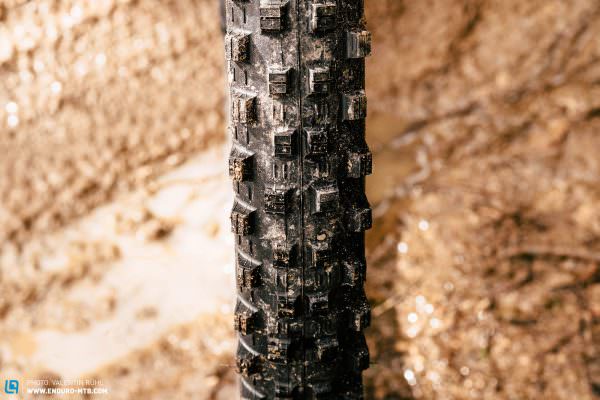
The MAXXIS Shorty is well-known as a mid-spike tire for winter slop and dusty conditions. The Shorty receives a new tread pattern and casing with added sipes in the tread. With its good mud-clearing abilities it is able to offer consistent traction in wet and muddy conditions. The new Shorty capably cuts its way through off-camber sections and mud and even maintains good traction on wet roots. However, as the surface gets rockier or harder, the pronounced shoulder lugs tend to fold despite their reinforcement, resulting in vague handling. All available versions are 2.4” wide but the rolling resistance is a bit too high to be used on the rear – front wheel only!
ASSEGAI
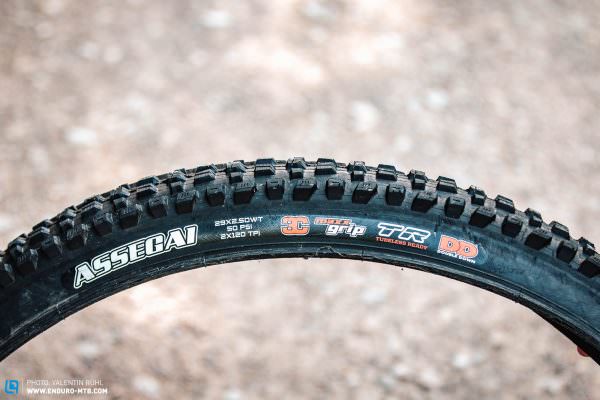
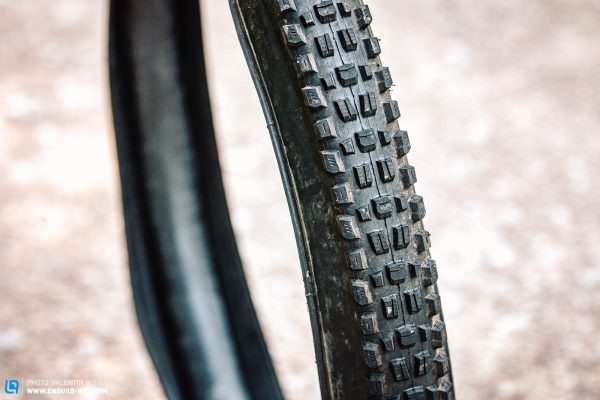
The MAXXIS ASSEGAI was designed by downhill legend Greg Minnaar. He combined all the positive qualities of the MAXXIS tires he has ridden in the past to create his perfect tire. The shoulder knobs are an interesting mixture of the HighRoller II and Aggressor. They dig into soft ground while offering a lot of support in berms. The centre tread consists of a single large central knob alternating with two smaller knobs. Braking traction is second to none, and it’ll hold its line even during hard braking manoeuvres on off-camber sections. You’ll quickly notice that the ASSEGAI was designed as a downhill tire when you feel its rolling resistance. Nevertheless, it is now available in all the lighter casing options as well, making it a great choice as a front tire on an Enduro bike.
Our recommendations
Enduro – full throttle (f/r): ASSEGAI, 3C MaxxGrip, Doubledown / Minion DHR II, 3C MaxxTerra, Doubledown
Enduro – all-round (f/r): Minion DHR II 3C MaxxTerra EXO+ / Minion DHR II 3C MaxxTerra Doubledown
Trail – fast rolling (f/r): Minion DHR II, 3C MaxxTerra, EXO / Aggressor, DualCompound, EXO
For more information head to maxxistires.de
Our big ENDURO group test at a glance
Here you’ll find everything you need about mtb tires: The Best Mountain Bike Tire – We had them all!
All the models in test


Did you enjoy this article? If so, we would be stoked if you decide to support us with a monthly contribution. By becoming a supporter of ENDURO, you will help secure a sustainable future for high-quality mountain bike journalism. Click here to learn more.
Words: Photos: Valentin Rühl